Tactical Sightings in Restricted Airspace
Declassified military intelligence records from March 1949 reveal a series of highly coordinated aerial violations over tactical zones that deeply challenged the defense capabilities of the United States armed forces. According to detailed observation logs and encounter summaries preserved between pages 95 and 102 of the Sandia official intelligence archive, multiple independent military units deployed on active guard duty simultaneously intercepted a group of unidentified anomalous phenomena (UAPs) operating with absolute impunity inside highly restricted federal sectors.
The tactical chronologies detailed in these operational files indicate that the events reached a critical peak during the first week of March 1949. Ground observers stationed across defense lines reported a formation of structured lights moving in unusual patterns. The group consisted of three brilliant amber-yellow lights and one distinct red light flying in a tightly synchronized formation. According to the defensive radar tracking summaries and physical coordinate logs found specifically on page 97, these objects did not follow any known ballistic trajectory, commercial flight plan, or meteorological pattern, immediately triggering a high-level security alert across the entire installation command.
Synchronized Military Eye-Witness Testimony
Unlike isolated civilian accounts that dominated early ufology archives, this specific defense emergency was documented by trained, on-duty military specialists. Security logs found on pages 98 and 99 confirm that a tactical unit patrolling “Area Q”—a zone dedicated to sensitive military projects—and a specialized four-man alert squad stationed permanently on the high-altitude Greenville Mountain ridge confirmed seeing the exact same phenomena at the exact same moments. The soldiers described the anomalous lights not merely as drifting elements, but as objects performing intelligent, interacting maneuvers, including sudden stops, rapid acceleration pulses, and sharp angular turns that defy conventional aerodynamic capabilities.
The field reports written by the commanding officers on the ground emphasize that weather conditions during the nights of March 6, 7, and 8 were completely clear, with excellent visibility and minimal wind interference. As noted in the official weather calibration charts attached to the final section of the file on pages 105 and 106, this data effectively ruled out thermal inversions, cloud reflections, or standard atmospheric anomalies. The four soldiers from the Greenville Mountain alert post provided individual, matching descriptions of the red object separating from the amber cluster, performing a low-altitude sweep near the military perimeter fence line, and then instantly climbing vertically until it disappeared into the upper atmosphere.
The Failure of Conventional Explanations
Immediately following these synchronized observations, intelligence officers from the Office of Special Investigations (OSI) and ground security elements launched a rigorous investigation to locate any physical trace of conventional operations in the area. Ground sweeps, civilian airport cross-checks, and commercial logistics reviews were conducted across the region. However, as the consolidated investigation report on page 101 strictly details, authorities failed to discover any record of private aviation, unauthorized military exercises, experimental weather balloon launches, or pyrotechnic testing that could account for the lights.
The sheer precision of the simultaneous sightings by geographically separated military patrols eliminated the possibility of optical illusions or localized hallucinations. Military specialists noted that the silent operation of the craft—which produced no audible propulsion sound or sonic booms despite moving at seemingly hypersonic velocities—indicated a technological paradigm completely detached from the known aviation engineering of the late 1940s. The documents prove that the intelligence wing was dealing with real, physical intrusions that easily bypassed the active defensive barriers established to protect national security assets.
Systemic Archives and the Modern UAP Puzzle
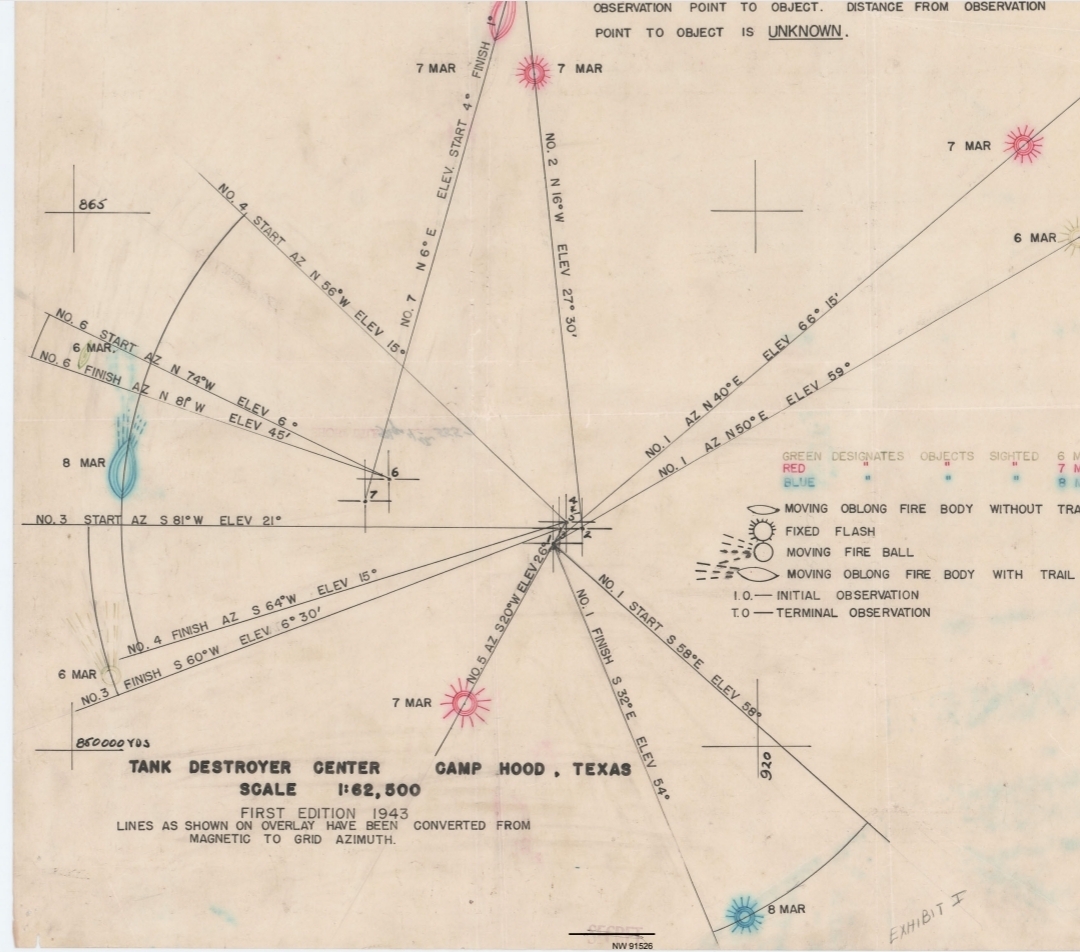
The historical significance of the March 1949 incursions lies in the systemic approach the military used to catalogue these events. The final pages of the declassified dossier, specifically pages 107 through 109, contain original hand-drawn tactical maps, triangulation charts, and ray-line graphs indicating the exact angles of observation from Camp Hood, Texas, to the central operational grid of the objects. These visual assets illustrate that defense agencies were treating UAPs as a highly serious tracking problem, using scientific methods to analyze altitude, speed, and behavior patterns decades before the modern implementation of digital sensor networks.
These archival records show that the core questions surrounding unidentified anomalous phenomena have remained unchanged for generations. The detailed observations of interacting lights over tactical perimeters in 1949 perfectly parallel modern military encounters reported by naval aviators and tracked by the Pentagon’s All-domain Anomaly Resolution Office (AARO) today. By providing readers with the exact page numbers and technical criteria used by researchers in 1949, this documentation bridges the gap between historical secrecy and modern disclosure, offering undeniable evidence that our skies have been shared with unknown technologies for much longer than officially acknowledged.
Deixe um comentário