Cold War Space Treaty Is Breaking: Who Will Control Near-Earth Orbit?,
An Ancient Law for a Modern Cosmic Frontier
The foundation of global space law, which has successfully governed human activities beyond Earth for nearly sixty years, is rapidly approaching a critical breaking point. According to a groundbreaking new analysis, the legal framework crafted during the height of the Cold War is completely unprepared for the impending era of commercial spaceflight and military orbit control.
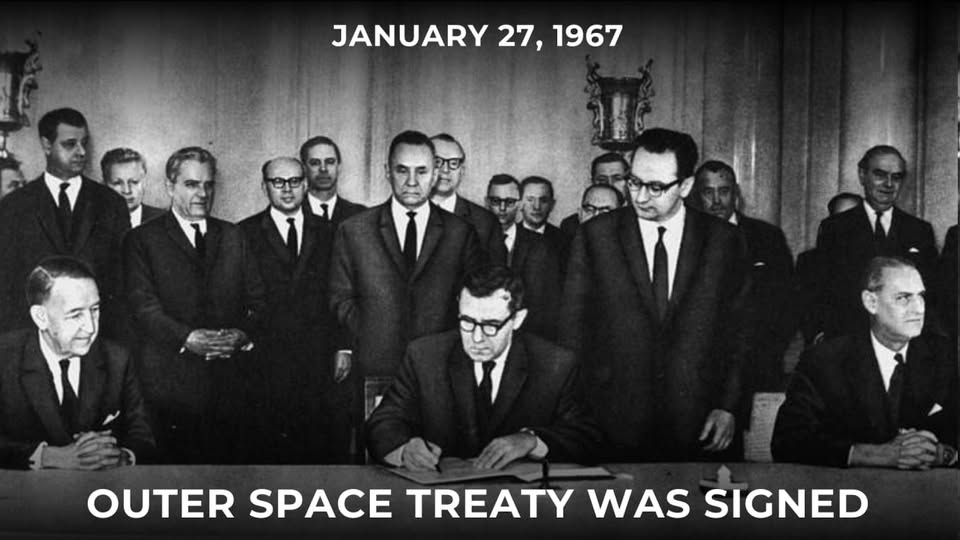
Published in the prestigious journal Frontiers in Space Technologies, the study warns that the historic 1967 Outer Space Treaty (OST) faces unprecedented threats. Between rising geopolitical rivalries on Earth and the sudden dominance of private aerospace corporations, the rules of outer space are being rewritten in real-time.
Astronomers Dr. John Barentine and Dr. Aparna Venkatesan argue that while the treaty was a triumph of its era, it cannot withstand the modern space race. As NASA, the Pentagon, and international adversaries turn their attention to the stars, the potential for unresolved conflict in near-Earth orbit has never been higher.
Born in the Shadow of the Cold War
The Outer Space Treaty was forged during one of the most dangerous periods in modern human history. Negotiated primarily by the United States and the Soviet Union, the document established vital boundaries for humanity’s expansion into the cosmos.
Among its most crucial tenets were strict bans on placing weapons of mass destruction in orbit and the prohibition of national sovereignty claims over celestial bodies. For decades, this historic agreement successfully prevented a catastrophic orbital arms race.
However, the researchers point out that the treaty was designed for an era when only two superpowers possessed launch capabilities. Today, dozens of nations operate advanced satellites, and private entities are launching rockets at a rate never before imagined, leaving major legal and moral questions unresolved.
The Threat of Orbital Militarization and Classified Anomalies
The study highlights a sobering reality: space exploration and military dominance have always been deeply intertwined. From the V-2 rockets of World War II to the launch of Sputnik in 1957, scientific achievements in space have often doubled as military demonstrations.
In recent years, the militarization of orbit has accelerated dramatically. Global powers like the United States, China, Russia, and India are investing heavily in anti-satellite weapons, advanced missile-defense architectures, and highly classified orbital assets.
For organizations monitoring the skies, this surge in military traffic creates a complex web of secrecy. With thousands of new satellites and secret payloads in orbit, distinguishing between classified military tech, space debris, and genuine UAP anomalies has become a daunting challenge for both NASA and independent researchers looking for the next orbital mystery.
A Looming Lunar Land Grab?
Perhaps the most urgent warning in the study concerns the Moon, which is quickly becoming a primary geopolitical flashpoint. With multiple nations successfully landing spacecraft on the lunar surface, plans for permanent bases and resource extraction are rapidly moving from science fiction to reality.
Because the Outer Space Treaty bans sovereignty claims but fails to address resource ownership or “exclusion zones,” the first nations to establish a presence could effectively monopolize the most valuable areas. This loophole risks igniting a dangerous rush for lunar territory, despite the treaty’s cooperative spirit.
Furthermore, the threat of orbital debris looms large over all space-faring nations. Destructive kinetic actions or satellite collisions in orbit can generate thousands of fragments that persist for decades, threatening spacecraft, scientific missions, and tracking operations worldwide.
Treating Space as a Protected Environment
Rather than calling for the complete abandonment of the Outer Space Treaty, the researchers advocate for a profound shift in how we view the cosmos. They suggest drawing inspiration from the global “Rights of Nature” movement, which views ecosystems as having intrinsic rights to exist and thrive.
By treating near-Earth orbit and celestial bodies as environments deserving of stewardship rather than resources to be exploited, humanity might avoid repeating the ecological mistakes made on Earth. Models of international cooperation, such as the peaceful management of Antarctica, could provide a blueprint for the future.
“The fundamental challenge lies in defending the space environment from failure of human goodwill and trust,” the authors conclude. As disclosure efforts continue and the mystery of what lies beyond our atmosphere deepens, establishing clear, cooperative rules for the cosmos has never been more vital.
Image Suggestion: A dramatic, cinematic digital art piece showing the Earth from orbit, surrounded by a dense network of glowing satellites and a futuristic military spacecraft patrolling the edge of space, with the Moon visible in the background under a starry, mysterious cosmos.
Deixe um comentário