The Djupsjøen Expedition: How Sonar Imagery Uncovered a 77-Year-Old Deep Lake UFO Wreckage in Norway
The frozen landscapes of Scandinavia have once again become the epicenter of international anomaly research following a groundbreaking underwater discovery. A team of highly specialized European researchers, utilizing state-of-the-art marine mapping equipment, has located what is believed to be a 77-year-old deep lake ufo wreckage submerged at the bottom of Lake Djupsjøen, Norway. This modern technological breakthrough directly aligns with historical eyewitness accounts dating back to 1947—the exact same pivotal year as the famous Roswell incident in the United States—when local villagers reported a sleek, wingless aerial craft performing impossible maneuvers before executing a controlled crash into the remote icy waters.
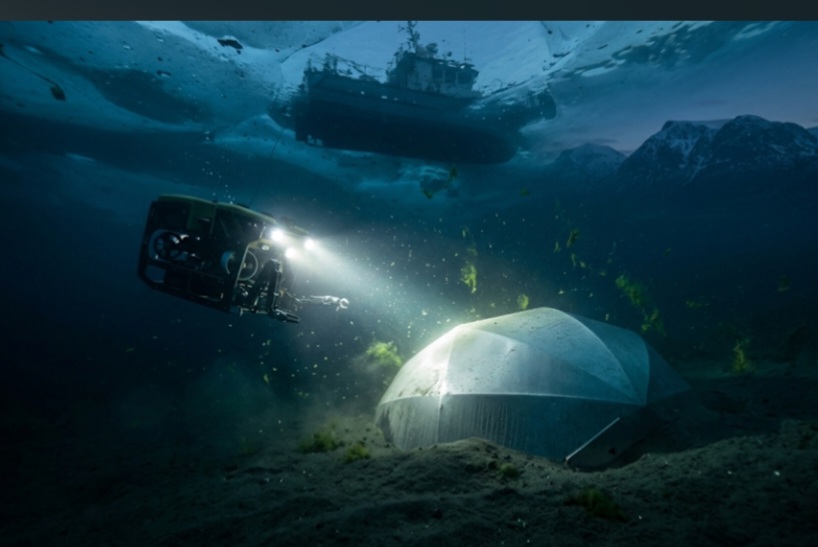
For nearly eight decades, the operational reality of this Scandinavian anomaly remained buried beneath dense layers of sediment and historical skepticism. However, the recent djupsjøen expedition, spearheaded by dedicated investigators Rune Østebø and underwater photography expert Espen Bakke, utilized advanced multi-beam echo-sounders to penetrate the dark depths of the lake. The resulting high-resolution sonar profiles shocked the team, revealing a highly geometric, anomalous object measuring approximately 10 meters (33 feet) in length. The distinct shape and structural clean lines of the target rule out natural geological formations, indicating that a solid, manufactured craft has been resting undisturbed on the lake bed since the mid-20th century.
Advanced Sonar Technology vs. Submerged Aerospace Anomalies
The logistical challenges of recovering artifacts from a sub-zero, high-altitude body of water have historically prevented thorough scientific investigations. Previous operations in the early 1970s lacked the digital processing power to isolate the craft from the surrounding glacial silt. This modern norway ufo search marks the first time that civilian researchers have successfully bypassed institutional gatekeepers by deploying commercial-grade subsea tracking equipment. The objective telemetry gathered by the echo-sounder arrays suggests that the object retained its structural integrity upon impact, hinting at an incredibly durable material composition that defies standard mid-century aviation engineering frameworks.
To systematically analyze the submerged target, the exploration team is currently coordinating a multi-phase extraction and analysis strategy:
- ROV Deep Deployment: Launching a remote-operated vehicle equipped with 4K optical cameras to capture the first close-up visual evidence of the hull material.
- Sediment Core Sampling: Extracting core layers surrounding the craft to radiometrically date the exact moment the object settled on the lake bed.
- Magnetic Anomaly Mapping: Utilizing sensitive magnetometers to determine if the object possesses an active electromagnetic signature or non-standard metallic alloys.
Local historians note that the 1947 encounter was heavily monitored by regional defense forces at the time, yet official archives remained conspicuously silent regarding any formal recovery attempts. This systematic lack of official reporting has led international analysts to believe that European intelligence agencies chose to leave the object submerged rather than risk a public geopolitical confrontation over non-human technology during the onset of the Cold War.
Breaking the Global Multi-Generational Submerged Cover-Up
The discovery at Lake Djupsjøen serves as a powerful reminder that physical evidence of these anomalous operations is not confined to heavily guarded desert military bases or classified government warehouses. Often, the most profound historical secrets are preserved by nature itself, waiting for commercial technology to catch up with the truth. As civilian exploration teams continue to independently verify these historical crash sites, the institutional narrative designed to enforce absolute silence on a global scale is rapidly disintegrating.
This inevitable shift toward public verification and transparent oceanographic research perfectly mirrors the ongoing political struggles taking place in Washington and across international defense networks. Insiders are increasingly stepping forward to expose how intelligence agencies have systematically hidden telemetry data from the public for generations. To understand how prominent whistleblowers are fighting to dismantle these exact corporate and military barriers, read our comprehensive feature on the Luis Elizondo Government Coverup History and the Modern UFO Disclosure Push, exposing how the global infrastructure of secrecy is facing an uncompromised, data-driven collapse across every environment on Earth.
Deixe um comentário