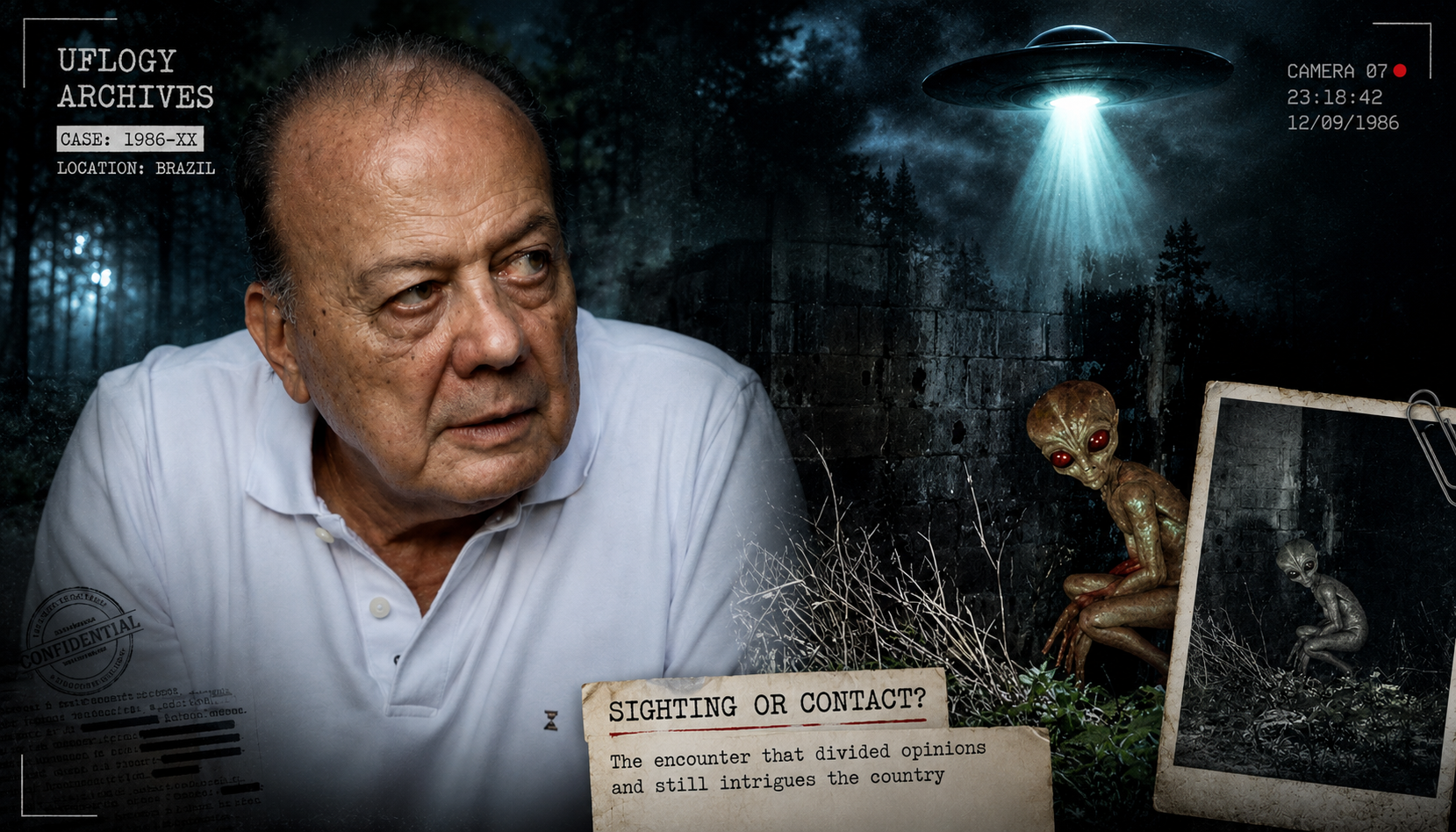
The intersection of medical testimony, military secrecy, and one of Latin America’s most enduring extraterrestrial encounters has resurfaced through an unprecedented personal account. Following thirty years of silence, neurosurgeon Ítalo Venturelli has come forward with a detailed first-hand narrative regarding the events surrounding the so-called “ET of Varginha,” a case that has occupied a singular position within Brazilian ufology since January 1996. His decision to speak publicly, shared directly with Metrópoles, reframes a regional legend through the lens of direct clinical proximity to the alleged entity.
According to Venturelli, the sequence of events began in the immediate aftermath of a pediatric surgical procedure he performed at a hospital in Varginha. Returning to the facility after a brief visit to his private clinic, he encountered an unusual security posture: the hospital and its surrounding perimeter, including the parking structure, had been sealed off, with military transport vehicles positioned at the site. This shift from routine clinical activity to apparent containment protocol forms the foundational anomaly of his account.
A Direct Clinical Encounter
The physician describes being approached by a journalist who posed a question he initially failed to process — whether he had operated on an extraterrestrial being. Shortly afterward, a colleague, since deceased, directed him toward an improvised examination space. It was there, according to Venturelli, that he encountered a being whose morphology diverged sharply from recognizable human or animal physiology: a teardrop-shaped head, eyes of similar configuration, and an overall presentation initially mistaken for a child with congenital malformation.
Morphological and Behavioral Indicators
Venturelli’s account, synthesized from his statements, outlines a consistent set of physical and behavioral characteristics attributed to the entity:
- Pale, whitish skin tone
- Disproportionately large, teardrop-shaped cranial structure
- Large lilac-colored eyes, teardrop-shaped
- Calm, non-aggressive demeanor
- Absence of detectable odor
Beyond physical description, the neurosurgeon emphasized a perceived asymmetry in the encounter itself — describing the unsettling impression that the being was the one conducting an examination, rather than the reverse. He further characterized the entity as projecting a level of apparent intelligence and emotional composure inconsistent with distress or aggression.
Decades of Concealment, and a Delayed Disclosure
Venturelli’s decision to remain silent for three decades, he explains, stemmed from anticipated social and professional consequences — including strained relationships with close family members who, he states, were never informed of the encounter. It was only following a personal health crisis that he began revisiting the episode publicly, eventually participating in conferences and discussion panels on the subject, including travel to the United States to present his account before international audiences.
Convergence With Broader Disclosure Narratives
Venturelli’s testimony arrives amid a renewed wave of public attention to the Varginha case, catalyzed in part by filmmaker Steven Spielberg’s recent public acknowledgment of familiarity with the incident, alongside his claim that the alleged entity was subsequently removed from Brazilian territory by U.S. personnel. This has been further compounded by former Brazilian Defense Minister Aldo Rebelo’s statements — cited by U.S. Congressman Eric Burlison during a congressional discussion on unidentified aerial phenomena — asserting that Brazilian military forces had recovered a craft and non-human remains in connection with the 1996 events.
Venturelli himself maintains that he possesses no direct knowledge of how the entity arrived at or departed from the hospital, stating only that the memory of those minutes remains vivid more than thirty years later.
Deixe um comentário