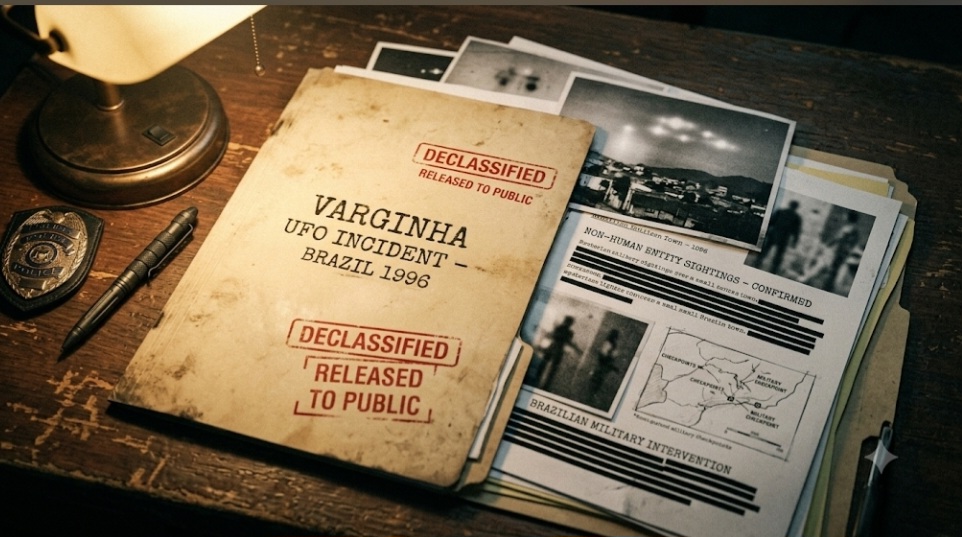
The Official Night of the UFOs: How 21 Objects Invaded Brazilian Airspace and Forced a Scramble of FAB Fighter Jets
On May 19, 1986, South America became the epicenter of one of the most thoroughly documented and sensational military encounters in modern ufology, an event historically recognized as the official night of the ufos. Over the course of several tense hours, the sovereign brazilian airspace—primarily over the heavily populated southeastern region—was penetrated by multiple anomalous glowing objects that completely compromised national security. The Integrated Air Defense and Air Traffic Control Center (Cindacta) detected more than two dozen unidentifiable radar targets performing maneuvers that defied the known laws of physics. Faced with an uncoordinated, high-velocity intrusion, the Aerospace Defense Command immediately scrambled elite fab fighter jets in a maximum-alert effort to intercept the anomalies, initiating an extraordinary military operation that remains unparalleled in aviation history.
The immediate tactical response involved F-5E Tiger II and Mirage III supersonic interceptors launched from Santa Cruz and Anápolis air force bases. Upon reaching the coordinates provided by ground radar operators, highly experienced military pilots reported direct visual contact with multicolored, self-luminous spheres that rapidly altered their intensity and executed impossibly sharp turns. In subsequent official debriefings that forever altered the study of aerospace phenomena, the jet pilots described how these entities appeared to intelligently interact with their aircraft. The targets would instantaneously accelerate to hypersonic velocities exceeding Mach 15 or drop into a complete, motionless hover directly in front of the pursuing military jats, making standard interception tactics completely obsolete.
The Aeronautics Ministry Report and the Validation of Solid Targets
What sets this specific encounter apart from global UFO lore is the unprecedented level of immediate institutional validation it received from defense officials. Days after the widespread sightings, the Brazilian Minister of Aeronautics convened a historic, televised press conference openly admitting that national defense infrastructure had engaged solid, intelligently controlled objects. Decades later, following an aggressive civilian freedom of information campaign, the official military dossier concluded that the anomalies were undeniably physical and possessed a distinct capability to produce coordinated radar echoes. This landmark declassification permanently validated the reality of this intense, government-documented ufo chase over major metropolitan areas.
The extensive military documentation subsequently released highlights three critical pillars regarding the physical nature and tactical behavior of these intruding intelligences:
- Simultaneous Multi-Sensor Confirmation: The objects were simultaneously tracked by military ground radars, civilian air traffic control arrays, and the onboard radar systems of the interceptor jats, entirely ruling out atmospheric anomalies or equipment malfunctions.
- Inexplicable Aerodynamic Capabilities: The glowing spheres varied in apparent size and shifted from subsonic cruising to over 15,000 km/h in fractions of a second without generating the mandatory sonic booms associated with terrestrial aircraft.
- Coordinated Defensive Evasion: The 21 targets operated in a fluid, decentralized formation but reacted in unison, executing evasive maneuvers the exact moment the fighter jats attempted to achieve a weapon-grade radar lock.
The profound paradigm shift triggered by this operation heavily influenced how South American militaries catalog anomalous aerial encounters. While global superpowers maintained a strict architecture of denial, Brazil’s open-archive policy allowed aerospace engineers to rigorously analyze the azimuth data, searching for the underlying propulsion mechanics that allowed such overwhelming technological superiority over the nation’s top interceptors. This historical legacy of transparency continues to serve as a benchmark for modern disclosure advocates worldwide.
This captivating chapter in defense history proves that monitoring unknown technologies requires absolute vigilance across all physical domains. While Brazil engaged these threats at high altitudes within the atmosphere, independent exploration teams elsewhere show that these identical technological mysteries may be preserved in vastly different environments. To see how advanced marine scanning arrays are exposing historical anomalies beneath the waves without relying on military permission, read our exclusive feature on The Djupsjøen Expedition and the Submerged Object in Norway, linking physical European evidence with the dramatic aerial pursuits that redefined Latin American defense history.